Introduction to Speech Recognition Software
Speech recognition software has transformed the interaction between technology and individuals, especially those with disabilities, by making digital content more accessible. This technological advancement enables the conversion of spoken language into text, enhancing users’ ability to efficiently navigate devices and applications. Understanding how this software operates, its core technologies, and its wider applications is crucial to appreciating its importance in modern digital communication.
How Speech Recognition Software Works
At the heart of speech recognition technology lies a sophisticated process of transforming auditory inputs into written language. This translation process hinges on the analysis of sound wave patterns produced by a user’s voice. The software compares these vibrational patterns against an extensive database of language inputs, functioning much like a predictive text system. As the software identifies the patterns, it converts them into text that reflects the speaker’s intended communication. Over time, the software’s reliance on machine learning algorithms allows it to improve its accuracy by studying user-specific accents and speech idiosyncrasies.
Key Technologies Involved
Several foundational technologies underpin the functionality of speech recognition software. A critical component is acoustic modeling, tasked with recognizing the unique phonemes, or fundamental sound units, that compose spoken words. For the system to construct coherent sentences from these phonemes, language modeling comes into play. This technology predicts word sequences to create meaningful sentences, akin to piecing together a puzzle. Additionally, speech segmentation plays a role by distinguishing separate words within a continuous flow of speech, ensuring that the resulting text is accurate and understandable.
Importance for Accessibility
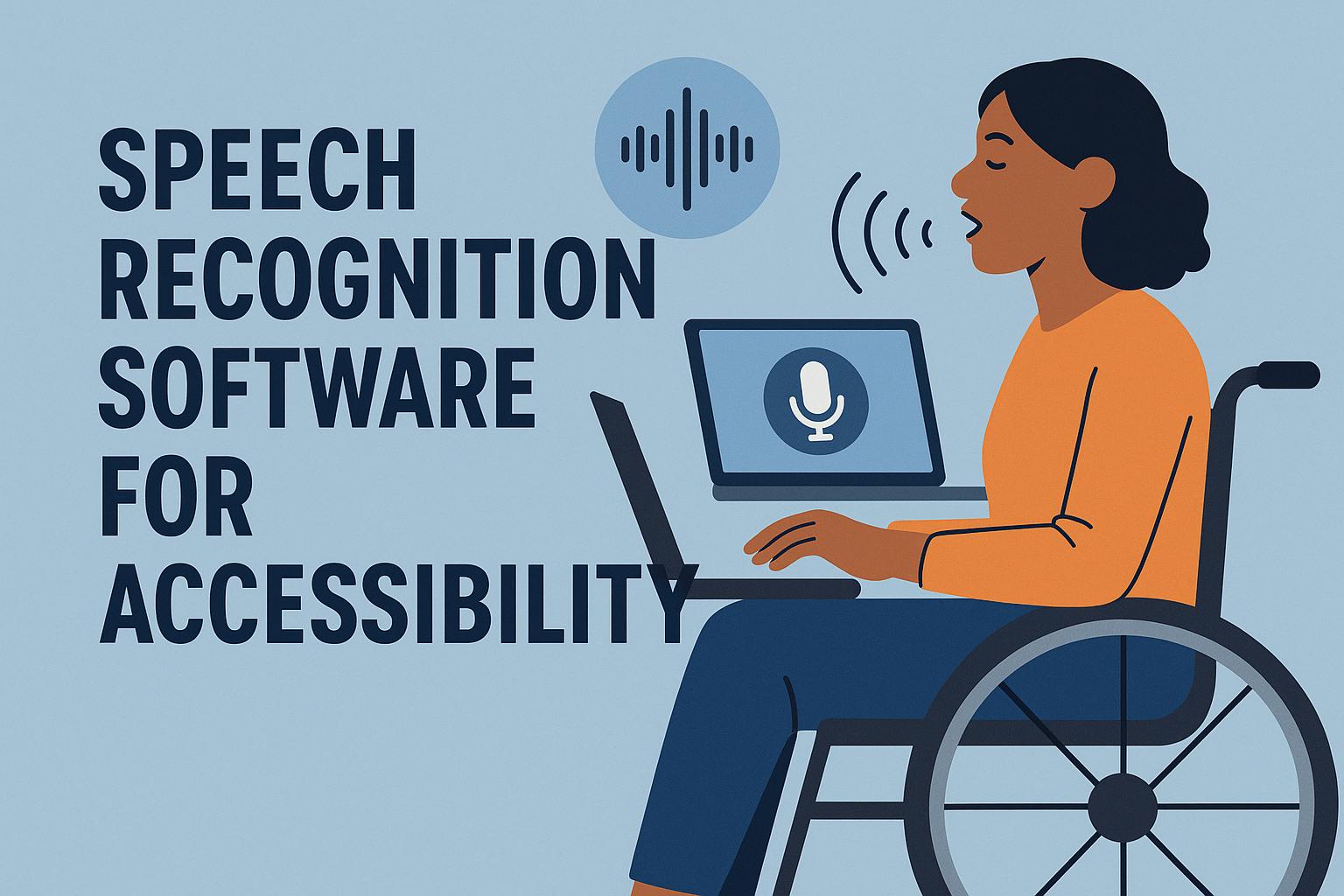
For users with disabilities—whether mobility, visual, or learning-related—speech recognition software is often indispensable. It offers a means to control various devices and technological platforms without the need for physical interaction. This capability is a game-changer for individuals who might find conventional input methods challenging or impossible to use.
Benefits for Users
Utilizing speech recognition software provides several significant advantages for accessibility, which include enabling users with restricted hand functionality to type and operate software. It allows visually impaired users to interact with technology through audio responses, fostering a more inclusive environment. Moreover, individuals facing learning difficulties can benefit tremendously as they can author and edit content with greater ease and reduced barriers.
Popular Speech Recognition Software
The market for speech recognition software is thriving, with numerous applications dedicated to enhancing accessibility. Leading platforms such as Google Assistant and Apple’s Siri provide robust voice-based services integrated into smartphones and other smart devices. These assistive technologies allow users to perform tasks ranging from simple inquiries to more complex device management. On the other hand, specialized software like Dragon NaturallySpeaking focuses on detailed dictation and offers comprehensive controls and customization, particularly useful for users who require robust, detailed speech-to-text solutions.
Challenges and Limitations
Despite their sophisticated nature and ongoing improvements, speech recognition systems are not without challenges. They notoriously struggle with interference from background noise—a common issue when users are in chaotic environments. Additionally, they can face difficulties in accurately handling a wide array of accents and in distinguishing between homophones, which are words that sound alike but have distinct meanings. These challenges can lead to occasional misinterpretations and inaccuracies in the text output.
Overcoming Challenges
Developers are continuously working on methods to mitigate these issues. One area of focus is the enhancement of noise-cancellation technologies to minimize interference from ambient sounds. Refining language models is another priority, enabling more accurate interpretation of diverse accents and phonetic nuances. Users, too, can contribute to addressing these challenges. By actively engaging with the training features of their speech recognition software, users can help these systems learn and adapt better to their specific speech patterns, leading to improved recognition and accuracy over time.
Future of Speech Recognition in Accessibility
The trajectory of speech recognition software points to an increasingly precise and adaptable future. Advances in artificial intelligence and machine learning are slated to refine these technologies further, leading to broader and more effective applications. As these technologies grow more sophisticated, the personalization of user experiences becomes possible, allowing accessibility features to be tailored to meet individual needs more effectively.
Ongoing Research
Research in the field of speech recognition is both active and expansive, aiming not only to resolve current limitations but also to explore novel applications. One exciting area of research is the creation of systems capable of understanding conversational context and differentiating between multiple speakers in a dialogue. This development could revolutionize how speech recognition software interprets interactive, multi-user environments, enhancing its functionality and applicability in diverse settings.
Speech recognition software holds immense potential to enhance accessibility and bridge communication gaps for users with a wide range of disabilities. As it continues to evolve, the promise of greater inclusivity and simplified technology interaction looks set to transform the future landscape of digital communication.